UV Seams
This example visualize UV seams of a model. It assumes the UV coordinates are stored in the texcoord attribute. Boundary(attributes=["texcoord"]) unifies the UV index buffer before selecting topological and attribute boundaries.
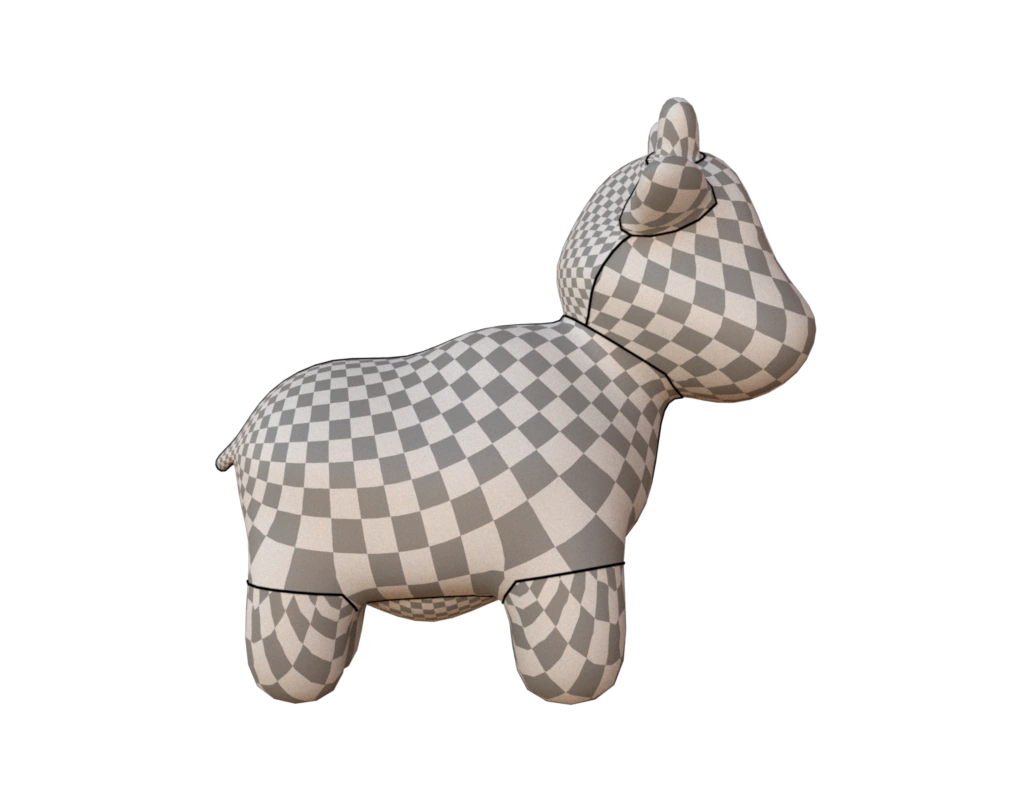
Data
The quadrangulated Spot model is by Keenan Crane and is released into the public domain. Its indexed texcoord attribute defines the UV seams.
Input contract
mesh: surface fromdata/spot_quadrangulated.obj;texcoord(indexed 2-channel uv).
Reproduce and inspect
Python · Manifest · Inspection · Canonical JSON · Validation
Code
#!/usr/bin/env python

import hakowan as hkw

hkw.set_default_backend("mitsuba")

uv_name = "texcoord"

base = hkw.layer("data/spot_quadrangulated.obj")
surface_view = base.name("Surface").material(
    "Principled",
    hkw.texture.Checkerboard(
        uv=hkw.attribute(uv_name), texture1=0.5, texture2=0.8, size=64
    ),
)
seam_view = (
    base.transform(hkw.transform.Boundary(attributes=[uv_name]))
    .name("Seam")
    .mark("Curve")
    .material("Diffuse", "black")
    .channel(size=hkw.channel.Size(data=3, space="screen"))
)

figure = (
    hkw.figure(surface_view + seam_view)
    .camera("perspective", eye=(3.5, 0, 0), up=(0, 1, 0))
    .environment(up=(0, 1, 0))
)

RECIPE_FIGURE = figure
RECIPE_INSPECTIONS = {"mesh": "data/spot_quadrangulated.obj"}

hkw.render(figure, filename="results/spot_seam.webp")
hkw.render(figure, backend="webgl", filename="results/spot_seam.html")